
目錄
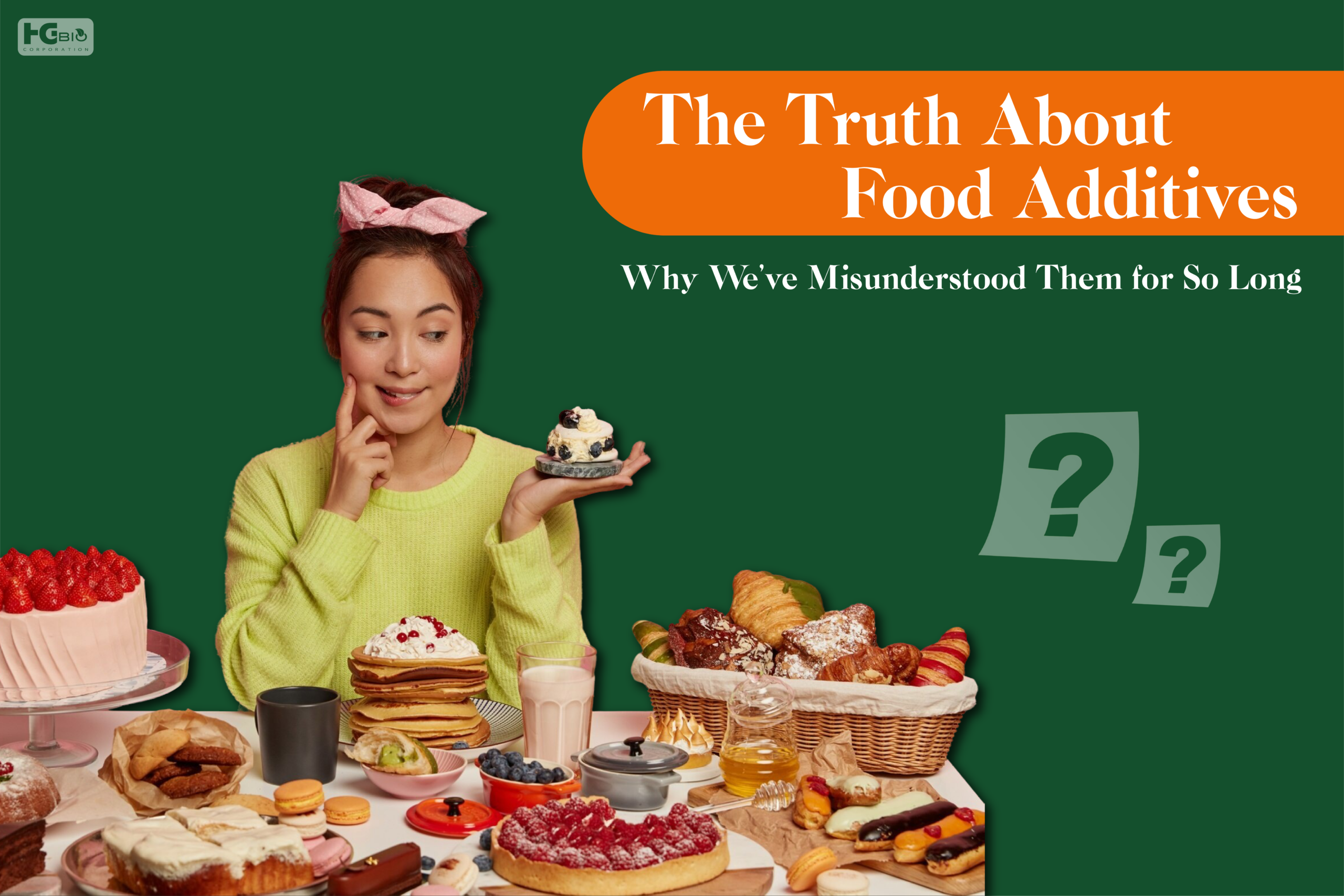
Why Do We Instinctively Fear Food Additives?
When you scan the ingredient list of a beverage, jelly, or vitamin tablet, you may come across names that sound like they belong in a chemistry textbook: Citric acid. Potassium sorbate. Silicon dioxide. Magnesium stearate.
And a quiet thought follows:
“Are these really safe to consume?”
Public skepticism toward food additives often stems from collective memory.
Past food safety scandals created an association between “added ingredients” and “adulteration.”
Meanwhile, marketing slogans like “No Additives” have reinforced the perception that “added” means “unnatural.”
But we rarely pause to ask:
- Why were food additives introduced in the first place?
- Why are they essential in modern food production?
The reality is simple:
Food additives were not created to deceive consumers — they were developed to help food maintain its quality, safety, and stability throughout processing, storage, and transportation.
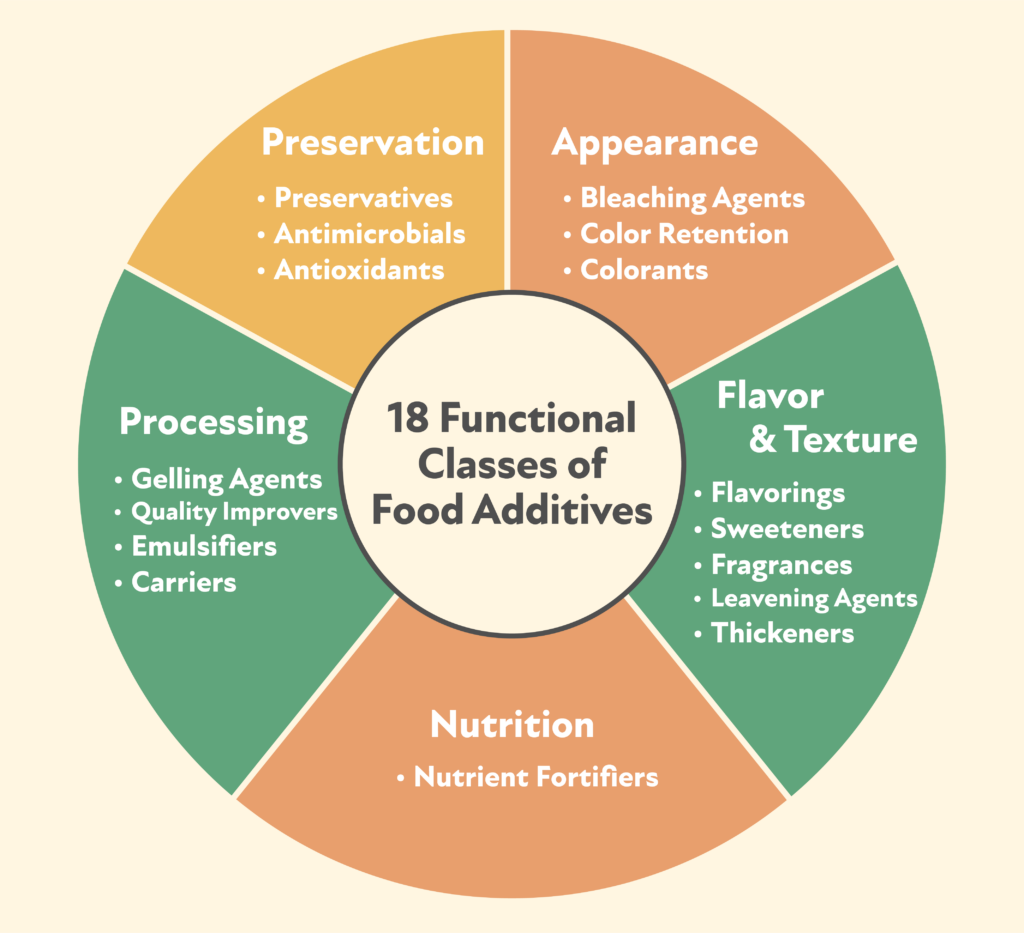
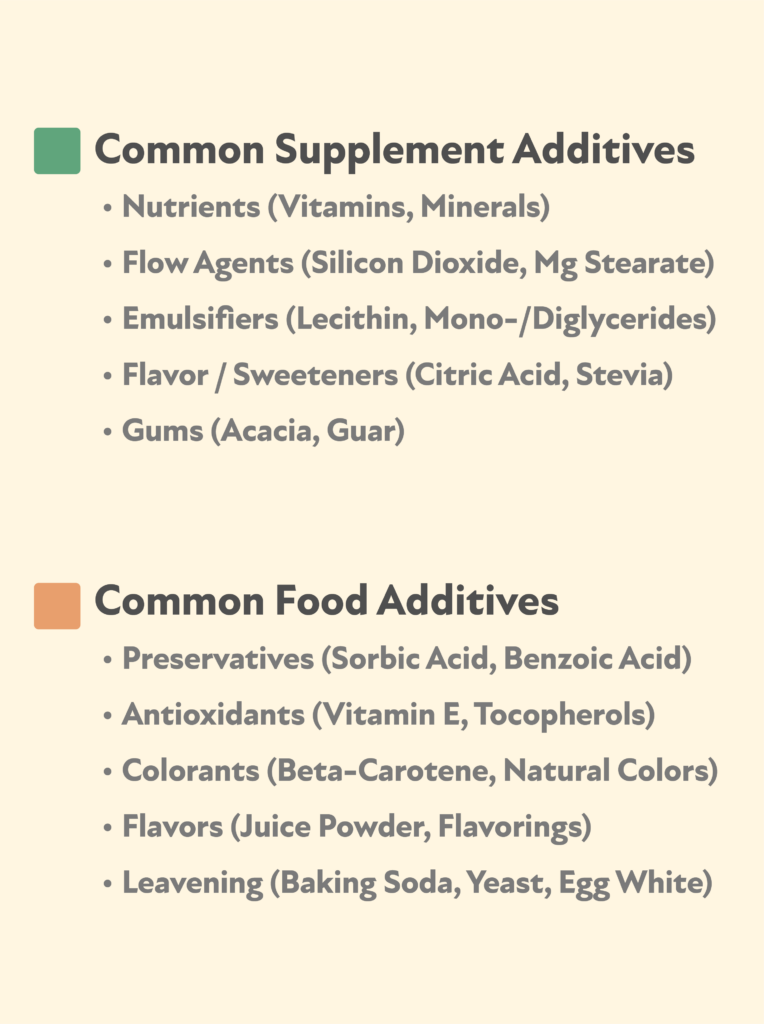
7+1 Classes of Food Additives (Sweeteners as Category 11) – At a Glance
What Are Food Additives? A Regulatory Perspective
Under Taiwan’s Food Safety and Sanitation Act (Article 3), food additives are defined as substances added to food for purposes such as:
- Coloring
- Flavoring
- Preservation
- Bleaching
- Emulsification
- Stabilization
- Fermentation
- Thickening
- Nutritional fortification
- Oxidation prevention
- Or other necessary technological functions
In other words, food additives act as a bridge — ensuring food products reach consumers with consistent quality and safety.
Without them:
- Juice could spoil within days
- Oils could develop rancid odors
- Powdered products could clump
- Sensitive nutrients could degrade
Taiwan currently classifies food additives into 17+1 functional categories (including sweeteners). Below are common examples, based on the official Standards for Scope, Application, and Limitation of Food Additives:
Category | Function | Common Examples |
Preservatives | Inhibit microbial growth, extend shelf life | Potassium sorbate, Benzoic acid |
Antioxidants | Prevent fat oxidation and rancidity | Vitamin E, Tocopherols |
Emulsifiers | Allow oil and water to blend | Lecithin, Mono- and diglycerides |
Thickeners / Gums | Improve texture and structure | Pectin, Xanthan gum |
Flavorings / Sweeteners | Balance flavor, mask bitterness | Citric acid, Steviol glycosides |
Colorants | Enhance or maintain color | Beta-carotene, Lutein |
Nutritional Fortifiers | Enrich nutritional value | B vitamins, Zinc, Magnesium |
Flow Agents | Improve powder flow and stability | Silicon dioxide, Magnesium stearate |
➜ For the complete list and regulatory details, visit the official website of the:
For information on food additive inquiries and the complete list of the 18 categories, please visit the official website of the Taiwan Food and Drug Administration (TFDA).
How Are Food Additives Regulated?
【The Core Principle: The Positive List System】
Taiwan adopts a Positive List System for food additives.
This means:
- Only substances officially approved by the government may be used.
- Each additive is permitted only within specific food categories.
- Usage levels are strictly limited.
- Unlisted substances — even if legal overseas — cannot be used in Taiwan.
Regulations clearly define:
- Scope of application
- Maximum permitted levels
- Purity standards
- Heavy metal specifications
Manufacturers must also obtain a Food Additive Registration Permit to ensure traceability and compliance.
These regulations are not barriers to innovation — they exist to ensure safety, transparency, and accountability.
- Dehydroacetic Acid (Preservative)
Permitted in cheese, butter, and margarine at ≤0.5 g/kg (calculated as dehydroacetic acid).
→ Function: Prevents microbial growth and extends shelf life. - Titanium Dioxide (Colorant)
May be used in appropriate amounts in most food categories, but prohibited in fresh meat, seafood, beans, vegetables, fruits, soy sauce, miso, seaweed, tea, etc.
→ Function: Provides opacity and product identification. - Ascorbic Acid (Vitamin C)
When used as an antioxidant, labeling must specify: “Vitamin C (Antioxidant).”
When used for nutritional fortification, it may simply be labeled “Vitamin C.”
→ The same substance requires different labeling depending on its function.
Is “No Additives” Really More Natural?
“No additives” and “preservative-free” claims have become popular marketing messages.
However, from a food science perspective, the absence of additives does not mean a product is untouched or completely natural.
Some products:
- Use high sugar or acidity to inhibit bacteria
- Rely on vacuum packaging
- Use refrigeration
- Apply concentration techniques
These are simply different preservation strategies. There is no absolute “better” approach.
The key question is not whether additives are used —
but whether the product complies with science-based standards and regulatory requirements.
Food Additives in Dietary Supplements: A Key to Complete Formulations
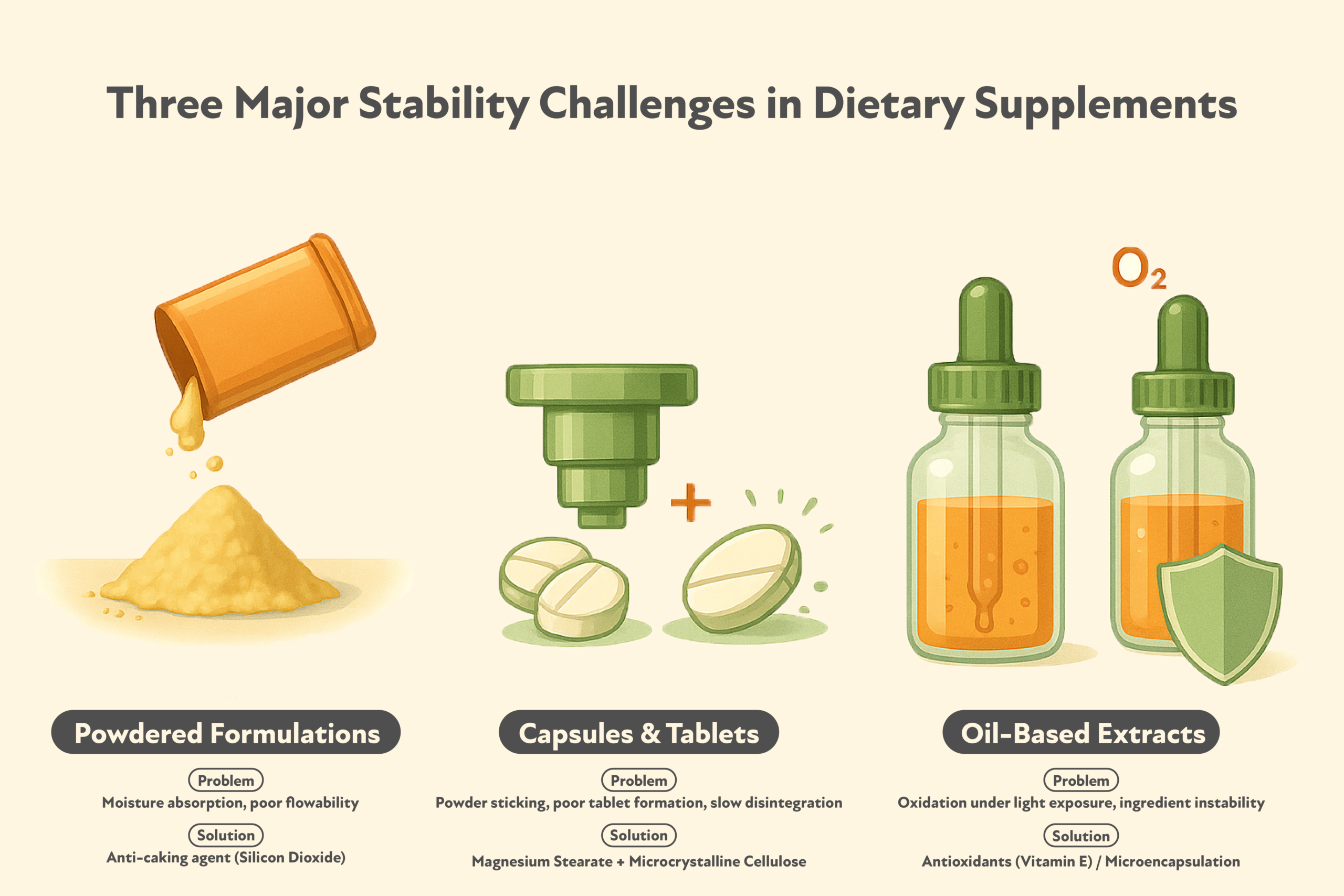
Dietary supplements often contain sensitive ingredients:
- Oil-based extracts (lutein, astaxanthin, omega-3) are prone to oxidation
- Probiotics are heat-sensitive
- Minerals absorb moisture and clump
Without stabilizers and antioxidants, products may degrade before reaching consumers.
Common Applications in Supplements
- Powdered Drink Mixes
Silicon dioxide (anti-caking agent) maintains flowability and prevents clumping. - Capsules & Tablets
Magnesium stearate (lubricant) and microcrystalline cellulose (disintegrant) ensure proper tablet formation and fast breakdown after ingestion. - Oil-Based Nutrients (Lutein, Astaxanthin, Omega-3)
Vitamin E or microencapsulation technology helps protect against oxidation and preserve bioactivity.
The purpose is not to “over-process,” but to protect ingredient stability and effectiveness.
How to Verify Additive Legality
Taiwan’s food additive safety system rests on three layers:
❶ Clear Labeling
Specific categories must disclose both name and function, e.g., “Benzoic Acid (Preservative).”
❷ Regulatory Compliance
Formulations must comply with the official standards for permitted use and specifications.
❸ Supplier Responsibility
Suppliers must hold valid registration permits and product registration codes for traceability.
Transparency builds trust — not just regulatory compliance.
Why Do We Still Distrust Additives?
The word “additive” often triggers associations with “artificial,” “chemical,” and “unknown.”
In psychology, this is known as semantic threat — unfamiliar names create discomfort.
If “citric acid” were described as “an organic acid naturally found in citrus fruits,” or “Vitamin E (antioxidant)” were labeled “natural Vitamin E protection,” consumer perception would shift dramatically.
Reassurance comes not from renaming — but from transparency.
HG BIO’s Perspective
Safety is not the result of “adding less.”
It is the result of understanding why something is added.
In dietary supplement formulation, every additive reflects a balance between:
- Stability
- Sensory quality
- Regulatory compliance
- Consumer experience
We believe:
Science enables nature to retain its value.
Understanding builds food safety.
Transparency preserves brand trust.
References
1️⃣ Belitz, H.-D., Grosch, W., Schieberle, P. (2019). Food Chemistry. Springer.
2️⃣ Taiwan Food and Drug Administration (TFDA). Standards for Scope, Application, and Limitation of Food Additives
3️⃣ Journal of Food Science and Technology, 2017; 54(10):3275–3283.
4️⃣ Taiwan Journal of Food Science and Technology, Vol. 46, Issue 4 (2019).